If You Bet on Anything in 2026, You'll Owe Federal Taxes on Money You Lost
A 2025 amendment to the federal tax code is about to hit every American bettor's 2026 return — sports, casino, poker, horse racing, lottery, all of it. FairBetAct is organizing to repeal it before it lands.
F
FairBetAct
April 30, 2026 · 8 min read
phantom-incomeobbbagambling-taxfair-bet-actbettor-rights
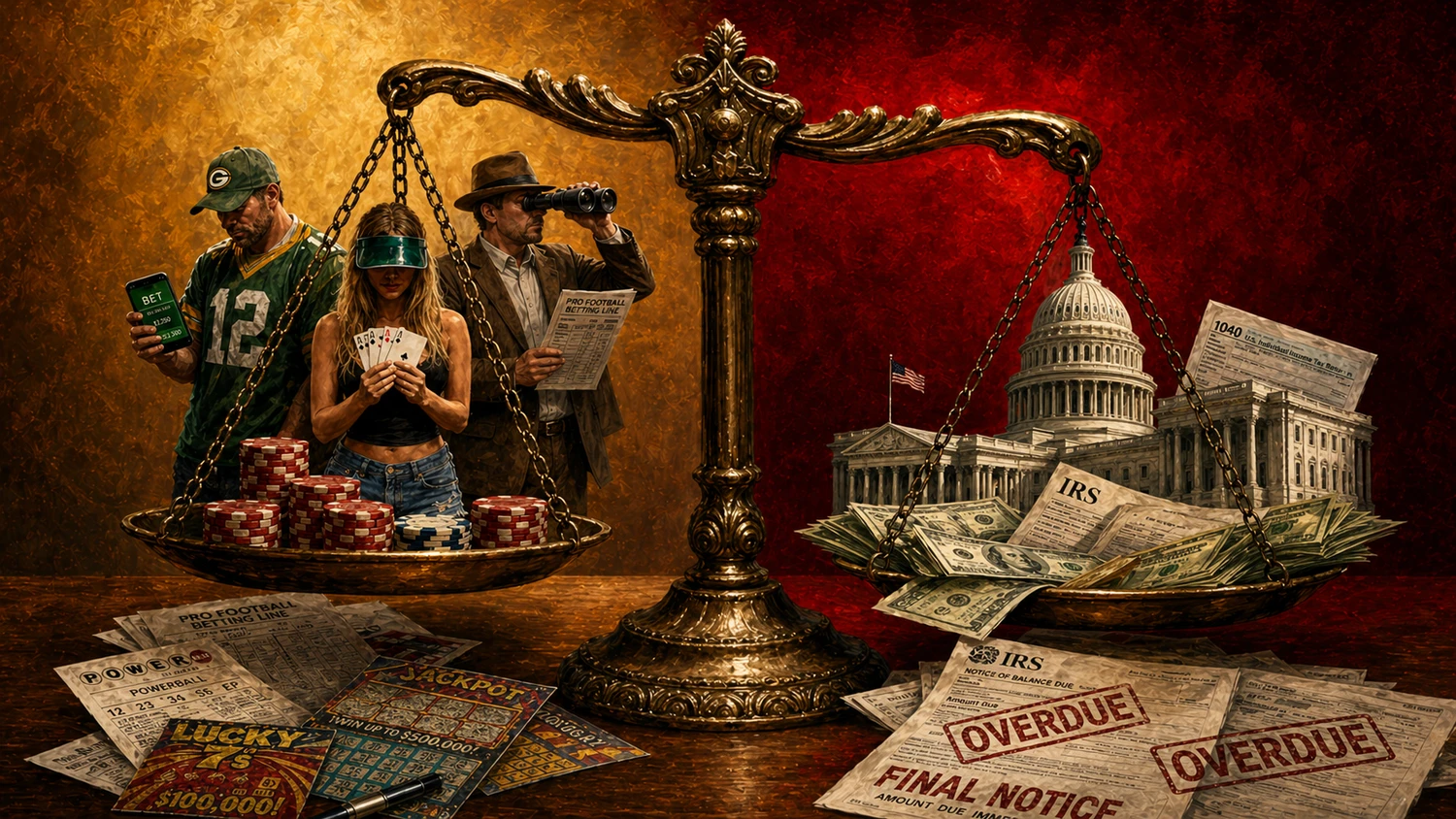
Imagine wagering $10,000 over a year of casual bets — Sunday parlays, March Madness lines, the occasional online poker session, a few weekends at the casino. Some hit. Most don't. By December 31, you've won and lost roughly the same amount. Net: zero. You're back where you started.
In April, you file your taxes and the IRS hands you a bill for $832.
That's not a hypothetical edge case. That's how the rule works for the ~90% of Americans who take the standard deduction. The IRS taxes their winning bets as income, but losses can't reduce that income — losses are only deductible if you itemize.
Most casual bettors never find out until their first tax season as a bettor.
It's a tax on income you never made. Accountants call it phantom income. Bettors who get hit by it call it something else.
What's actually happening
This rule applies to every form of legal gambling — sports betting, poker, casino games, horse racing, lottery winnings, daily fantasy. The mechanism is the same regardless of where you wager.
The IRS counts every winning bet as taxable income. Every winning bet, individually. Lose them all back the next week? Your losses are deductible — but only if you itemize.
About 90% of Americans take the standard deduction. They never get to deduct gambling losses at all. They pay tax on gross winnings as if those winnings stayed in their pocket. They didn't.
For the bettor in our $10,000 example: roughly $5,000 of those wagers hit, roughly $5,000 didn't. The IRS sees $5,000 of "income." The standard deduction does not absorb gambling losses. Result: federal tax owed on $5,000 of wins they no longer have. At a typical bettor's marginal rate, that lands around the $832 figure above.
That's the standard-deduction phantom-income trap. It's existed for decades. Now hold that thought.
How we got here — and what just changed
The current rule — IRC §165(d) — was first written in 1934. Section 23(g) of the Revenue Act of 1934 said: "losses from wagering transactions shall be allowed only to the extent of the gains from such transactions." Recodified into the modern Internal Revenue Code at §165(d) in 1954, that language has been there ever since.
What that 1934 rule actually did was break a parity that already existed. Before 1934, courts treated a legal gambler "entered into for profit" the way the tax code treats every other legal trade — losses from the activity could offset other income, the same as a butcher writing off unsold meat or a freelancer writing off equipment that didn't pay back. The 1934 Ways and Means Committee called gamblers' use of that rule an enforcement headache: many taxpayers, the committee said, were claiming losses without reporting gains. Their fix was a workaround. Lock losses to gambling income only. Force bettors to declare wins if they wanted to claim losses. The compliance argument may have made sense to a 1934 committee. The structural effect was to single out one category of legal economic activity and deny it loss-deductibility every other trade enjoys. That asymmetry has lived in the code for 92 years. It may not survive a serious constitutional argument under the 16th Amendment's realization principle — taxing gross wins when net wins are zero is taxing income that, in the Eisner v. Macomber sense, was never realized. We're not litigating that today. We're naming it.
The phantom-income hook in our $10,000 example traces to the next compounding layer: the standard deduction, introduced in 1944 and expanded steadily ever since. About 90% of Americans take it. Standard-deduction takers cannot itemize, and itemizing is the only way to access the limited gambling-loss deduction the 1934 rule allows. Result: bettors who don't itemize get taxed on gross wins as if their losses never happened. That asymmetry has sat in the code for 80 years — written before sports betting was legal in most states, before online poker existed, before tens of millions of casual Americans had any reason to wager.
The OBBBA is the third compounding layer.
Tucked into the One Big Beautiful Bill Act (OBBBA) was Section 70114 — a provision that amended IRC §165(d) to cap loss deductibility at 90% even for itemizers. Effective tax year 2026. Filing in April 2027.
Until OBBBA, an itemizing bettor who tracked carefully and broke even on the year owed nothing. From TY2026 forward, that same bettor pays tax on 10% of their losses. Win $50,000 and lose $50,000 in a year of high-volume sports betting and you'll owe federal tax on $5,000 of "income" that never existed. At a 22% marginal rate, that's a $1,100 tax bill on a year you broke even.
That's the new phantom-income trap. It hits the people who were doing everything right.
The OBBBA didn't break a fair system — the system was already imperfect, layer by layer. It broke the only safe corner of what was left, the one where compliant itemizers could net out wins and losses and not owe tax on money they never had. Each layer was sold as reasonable in its moment. Stacked together, they describe a tax code that treats betting differently than every other legal economic activity, and treats bettors worse with each iteration. The OBBBA is what we're fighting first because it lands hardest, fastest, on the most people. It is not the only thing wrong here, and we are not pretending it is.
Why we're publishing this now
You have eight months. Tax year 2026 is currently in progress. Every wager you place between now and December 31 will be subject to the new 90% cap when you file in April 2027.
Knowing the math is the first step. Joining the fight to repeal the OBBBA cap before it lands is the second. There's no third step that doesn't involve a tax bill nobody warned you about.
Who FairBetAct is
FairBetAct is a community-powered advocacy organization. We're bettors, CPAs, and people who got tired of explaining the phantom-income trap to their friends, their families, and themselves.
We exist to defend the constitutional rights of every American who places a legal bet — sports, casino, poker, horse, lottery, fantasy. The OBBBA cap is the immediate fight. But it isn't the only one. The U.S. has spent decades building a tangled, contradictory policy framework around gambling — taxing what's legal, prohibiting what's profitable elsewhere, treating bettors differently than any other class of taxpayer.
We're organizing for the long term. Every gambling bill that hits a state or federal floor should be heard against the standard of fair treatment for bettors. We'll be there for each one.
The remedy on the table — the FAIR BET Act
There's a bipartisan bill in the U.S. House right now — the FAIR BET Act, H.R. 4304, introduced by Rep. Dina Titus (D-NV-1) on July 7, 2025, with Rep. Ro Khanna (D-CA) as the lead Democratic cosponsor and 25 bipartisan cosponsors total as of April 2026. It does two things:
- Repeals the OBBBA 90% cap, restoring full loss deductibility under IRC §165(d) for itemizers.
- Includes structural reforms to how gambling income is reported, so casual bettors aren't accountant-dependent to avoid the phantom-income trap.
The bill was referred to the Ways and Means Committee in July 2025 and sat there for seven months. In February 2026, Rep. Titus filed a Motion to Discharge (Discharge Petition No. 119-16) — a procedural move that, if signed by 218 House members, forces a floor vote bypassing the committee entirely. That petition is the current path forward. It moves on constituent pressure asking your representative to sign. Not before.
Two parallel bills — the bipartisan FULL HOUSE Act in both chambers (Rep. Max Miller (R-OH-7) leading the House version with Rep. Steven Horsford (D-NV-4); Sen. Catherine Cortez Masto (D-NV) leading the Senate companion) and the WAGER Act in the House (Rep. Andy Barr (R-KY-6)) — would do the same thing. The bipartisan momentum is real. Discharge Petition 119-16 is the one with traction.
What you can do, today
- Add your name at fairbetact.com. Every signer is a public count of bettors who want the OBBBA cap repealed. Numbers are leverage — that's how stalled bills move.
- Share your story. If you've been hit by phantom income — or if you're looking at your 2026 wagers and bracing for the OBBBA — tell us. We're building a public record that Congress can't dismiss as a lobbyist's projection.
- Spread this article. Most bettors don't know the rule exists, and almost none know the OBBBA changed it. Share where it matters: a group chat, a subreddit, a podcast.
The bottom line
Breaking even isn't income. Breaking even should mean breaking even. It shouldn't mean owing the federal government taxes on money that never existed.
The math is simple. The fix is on the table. The only thing missing is the constituent pressure to move it.
That's what FairBetAct is for.
Your bet. Your money. Your fight.
Sources
- IRS Publication 525 — Taxable and Nontaxable Income (gambling section)
- IRC §165(d) — wagering loss limitation; originally enacted as Section 23(g) of the Revenue Act of 1934, which broke pre-1934 case-law treatment of legal-for-profit gamblers as ordinary trades-or-businesses (a legislative workaround to a reporting-compliance problem identified by the 1934 Ways and Means Committee, not a "loophole" closure in any neutral sense); recodified into the Internal Revenue Code of 1954
- H. Rept. 704, 73d Cong., 2d Sess. 22 (1934) and S. Rept. 558, 73d Cong., 2d Sess. — congressional intent for §23(g): "Under the present law many taxpayers take deductions for gambling losses but fail to report gambling gains. This limitation will force taxpayers to report their gambling gains if they desire to deduct their gambling losses."
- Eisner v. Macomber, 252 U.S. 189 (1920) — Supreme Court establishing realization as a defining element of taxable income under the 16th Amendment
- One Big Beautiful Bill Act, Title VII, Section 70114 (gambling loss deduction limitation, 90% cap on itemized losses, effective TY2026)
- FAIR BET Act — H.R. 4304, 119th Congress (Rep. Dina Titus (D-NV-1), sponsor; Rep. Ro Khanna (D-CA-17), lead Democratic cosponsor; 25 bipartisan cosponsors as of April 2026) — congress.gov/bill/119th-congress/house-bill/4304
- House Discharge Petition No. 119-16 — filed Feb 12, 2026 by Rep. Dina Titus to bring H.R. 4304 to a floor vote — clerk.house.gov/DischargePetition/2026021216
- FULL HOUSE Act — H.R. 6985 (Rep. Max Miller (R-OH-7), sponsor; Rep. Steven Horsford (D-NV-4), lead Democratic cosponsor; 6 cosponsors; introduced January 8, 2026) and S. 2230 (Sen. Catherine Cortez Masto (D-NV), sponsor; 8 bipartisan cosponsors; introduced July 9, 2025; pending in Senate Finance)
- WAGER Act (Winnings and Gains Expense Restoration Act of 2025) — H.R. 4630 (Rep. Andy Barr (R-KY-6), sponsor; 5 cosponsors; introduced July 23, 2025; first Republican-led House version pursuing the same restoration; Barr chairs the Congressional Horse Caucus)
Share this article